For learners with dyscalculia, cognitive impairment & multiple diagnoses
Most kids with serious learning differences can succeed at math. What’s missing isn’t ability. It’s the right support.
For the vast majority of these learners, a diagnosis describes how they learn, not whether they can.
See how Heliomath helpsof learners here have a learning difference
are managing two or more at once
the pace most learn at vs. traditional instruction
The science of timing
The earlier you start, the gentler the climb.
The reason is neuroplasticity — the brain’s ability to rewire itself as it learns. It’s a gift at every age, but strongest in childhood: younger brains adapt faster, with less effort. Start early, and the brain does more of the work.
Whatever your child’s age, their brain will never be more adaptable than it is today.
What families are saying
Our daughter has multiple issues going on with her at the same time, including an intellectual impairment which makes learning extremely difficult. She has struggled for years with math, and we are seeing great results so far with Heliomath!
Read more >>
Rosalee
Mother of one in San Diego, CA
I have been using this program called Heliomath and it has helped me move faster through Math. I like that it says it doesn't matter if you get the answer wrong. If you do get the answer wrong, it will help you to figure out the correct answer.
Read more >>
Charlotte
Special-needs learner in New York, NY
Heliomath is so user friendly, not only for the parents, but for the kids as well. My daughter is special needs, and still is able to follow along and benefit more so than from other apps we have used.
Read more >>
Joel
Father of one in San Diego, CA

Special needs learner catches up 1.5 grade-levels in under 4 months
Meet Autumn, an 11-year-old learner facing multiple learning challenges, including cognitive impairment, ADHD, level-2 autism, and bipolar disorder. Starting Heliomath on Oct 19th, 2023, she was assessed at 15% through the grade 2 curriculum, struggling even with... see more

Dyscalculic learner catches up 1.5 grade-levels in just 5 months
Meet Siena, a 12-year-old learner grappling with dyscalculia, and ADHD. With early signs of difficulty in counting and skip counting, Siena's struggles intensified through elementary school, leading to anxiety and aversion to math-related activities. After various school... see more

Autistic learner with speech delays advances 3 grade levels in under a year
Atlas (name changed to protect their identity) is a homeschooled learner with autism, speech delay, and expressive/receptive language disorder. These challenges make language-heavy subjects — especially word problems — particularly difficult. But with Heliomath, Atlas made rapid progress in math. see more
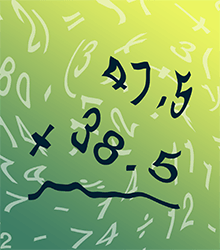
Dyscalculia
Dyscalculia is a complex learning disability that affects an individual's ability to understand and perform mathematical operations. Superficially, it appears to be similar to dyslexia, but specifically impacts math skills. It can range in severity, with some learners struggling with basic math concepts and others having difficulty with more complex calculations. Dyscalculia affects 5-7% of the population.
Symptoms of dyscalculia may include difficulty with:
- Counting and understanding numbers
- Understanding and using mathematical symbols and operations (such as +, -, ×, ÷)
- Estimating and measuring quantities
- Grasping math concepts, such as place value and fractions
- Solving math problems, even when given step-by-step instructions
- Understanding and using mathematical language in everyday situations
How Heliomath can help
- Breaks questions down into bite-sized steps
- Recasts questions in a wide variety of visual formats
- Automatically pinpoints the source of a learner’s difficulties
- Provides multisensory instruction
- Practices basic cognitive skills as needed
- Presents 1 question at a time in a simple, clutter-free UI that won't overwhelm learners
- Avoids painful (not to mention unhelpful) repetition
Dyslexia
Dyslexia is a neurological condition that affects an individual's ability to read, write, and spell. It is a common learning disability that affects about 10% of the population. When it comes to learning math, kids with dyslexia may have trouble reading math-questions, particularly word-problems.
Symptoms of dyslexia may include difficulty with:
- Recognizing and decoding words
- Comprehending what is read
- Spelling and writing
How Heliomath can help
- Provides multisensory instruction
- Recasts questions in a wide variety of visual formats
- Presents 1 question at a time in a simple, clutter-free UI that won't overwhelm learners
ADHD
Attention deficit hyperactivity disorder (ADHD) is a neurological condition that affects a person's ability to focus, control impulses, and regulate behavior. It is a common disorder that affects both children and adults.
Symptoms of ADHD may include difficulty with:
- Paying attention
- Staying organized
- Completing tasks
How Heliomath can help
- Provides multisensory instruction
- Recasts questions in a wide variety of visual formats
- Prompts learners to take frequent breaks
- Presents 1 question at a time in a simple, clutter-free UI that won't overwhelm learners
Level-2 Autism
Level-2 autism is a complex neurological condition that falls within the broader autism spectrum. Children with level-2 autism often find social interactions challenging and overwhelming, may prefer engaging in repetitive behaviors they can perform on their own, and typically require additional support to help them achieve academically.
Children with Level-2 Autism may experience difficulty with:
- Certain specific aspects of symbolic/abstract math (which may be concentrated on certain specific concepts, such as place-value in number-sense, and vary substantially from one child to another)
- Forming connections across different math-concepts that others might assume to be self-evident
- Maintaining focus if not interested in something
* It's worth noting that children with level-2 autism that develop an intense interest in math will often excel at it and significantly outperform their peers.
How Heliomath can help
- Recasts questions in a wide variety of visual formats, providing concrete anchors for the abstract symbols & concepts being presented
- When Heliomath breaks questions, problems, and concepts down into their sub-components, it preserves as much contextual information as possible (the specific numbers involved, the type of shapes being shown, their colors, etc) to create as much concrete continuity as possible
- Presents 1 question at a time in a simple, clutter-free UI that won't overwhelm learners
Math Anxiety
Math anxiety is an emotional response characterized by feelings of fear, tension, and apprehension when confronted with mathematical tasks or concepts. It can significantly hinder a person's ability to engage with and perform well in mathematical activities, even if they possess the necessary skills.
Symptoms of Math Anxiety may include:
- Nervousness or unease during math-related tasks
- Fear of making mistakes or being judged for mathematical abilities
- Avoidance of math-related activities or discussions
- Negative self-talk and self-doubt in mathematical situations
- Physical symptoms, such as sweating or an increased heart rate when tackling math problems
How Heliomath can help
- Math anxiety is not limited to any particular skill level and can impact learners of all ages. Our system is designed to be supportive and encouraging to help alleviate math anxiety.
- By breaking questions down into bite-sized steps, and recasting questions in a wide variety of visual formats (where symbolic math may be a stressor), our system helps build back confidence, reduce anxiety, and foster a positive attitude towards math
- Presents 1 question at a time in a simple, clutter-free UI to avoid overwhelming learners
Cognitive Impairment
Cognitive impairment is a broad term encompassing various conditions that affect cognitive functions, including memory, attention, problem-solving, and overall intellectual abilities. Individuals with cognitive impairment may face challenges in processing information and learning new concepts, making mathematics a particularly demanding subject. It can range from mild to severe.
Symptoms of Cognitive Impairment may include difficulty with:
- Retaining and recalling information
- Concentrating on complex tasks
- Grasping abstract mathematical concepts
- Applying problem-solving strategies
- Adapting to changes in mathematical procedures
- Organizing and sequencing steps in mathematical processes
How Heliomath can help
- Cognitive impairment can manifest in various forms and degrees, impacting each individual uniquely. As our math tutoring system is designed to adapt to different learning styles and paces, it can provide valuable support to learners with cognitive impairment by offering personalized assistance tailored to their specific needs.
- Breaks questions down into bite-sized steps
- Recasts questions in a wide variety of visual formats
- Automatically pinpoints the source of a learner's difficulties
- Provides multisensory instruction
- Practices basic cognitive skills as needed
- Presents 1 question at a time in a simple, clutter-free UI that won't overwhelm learners